PHAK Ch. 4 · study note
Bernoulli’s principle of differential pressure
In the Pilot’s Handbook of Aeronautical Knowledge, lift is introduced with Newton’s laws of motion and Bernoulli’s principle of differential pressure. This note is the PHAK pilot-level story—what you need for the knowledge test and clear mental models. For circulation, Kutta–Joukowski, and a fuller theory of lift, use the Lift Theory Lab.
The principle (one sentence)
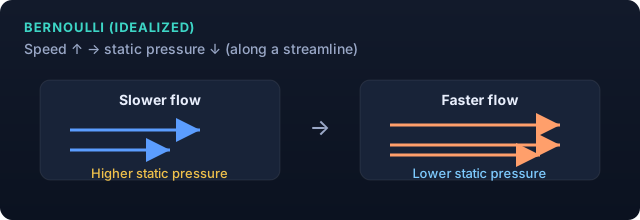
As the velocity of a moving fluid (liquid or gas) increases, the pressure within the fluid decreases. (PHAK Ch. 4)
“Pressure” here means static pressure—the pressure you would feel if moving with the fluid. Speed up the flow, static pressure drops; slow it down, static pressure rises (along a streamline, under the idealizations Bernoulli assumes).
The venturi: Bernoulli in a tube
PHAK’s practical demonstration is the venturi tube: inlet → narrow throat → outlet (same diameter as the inlet).
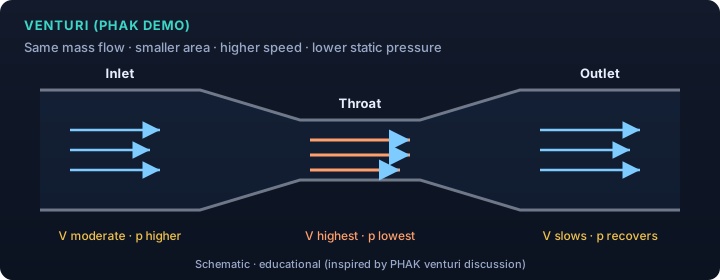
- Mass of air entering must equal mass leaving (continuity).
- At the constriction, speed increases so the same mass can pass in the same time.
- When speed increases, static pressure decreases.
- Downstream of the throat, flow slows and pressure recovers.
Same physics shows up in a float carburetor venturi: low pressure at the throat helps meter fuel into the airstream (and contributes to carburetor icing when moist air cools in that low-pressure region).
Application to a wing
An airfoil is shaped so that, at a positive angle of attack (and/or with camber), air moving over the upper surface is forced to move faster than air along the lower surface. By Bernoulli, higher speed above → lower static pressure above the wing.
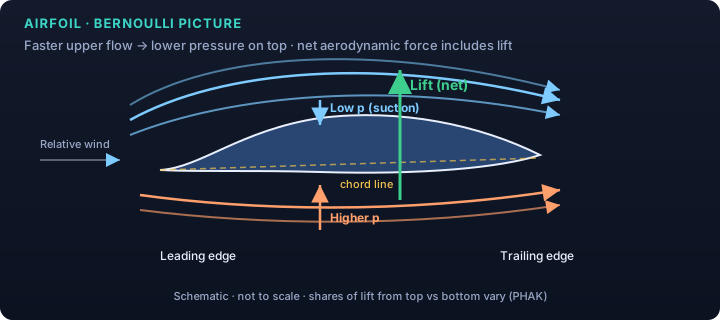
That reduced pressure on top is a component of total lift. Under the wing, flow is often slower in places (especially as angle of attack rises), so pressure can be higher than free stream—another contribution to lift.
PHAK is careful: it is neither accurate nor useful to assign fixed percentages like “70% from the top, 30% from the bottom.” Those shares change with design and flight condition.
Airfoil vocabulary (from the same chapter)
| Term | Meaning |
|---|---|
| Camber | Curvature of upper and lower surfaces (upper often more pronounced) |
| Chord line | Straight line from leading edge to trailing edge |
| Mean camber line | Line equidistant from upper and lower surfaces |
| Leading / trailing edge | Rounded front; tapered rear |
| Angle of attack (AOA) | Angle between chord line and relative wind |
| Center of pressure (CP) | Average location of the pressure distribution; moves with AOA |
Bernoulli is not the whole story (PHAK says so)
- Lift is more complex than a simple pressure difference alone.
- Symmetrical airfoils (same upper and lower shape) still produce lift when flown at AOA—so “longer path on top” is not a complete explanation.
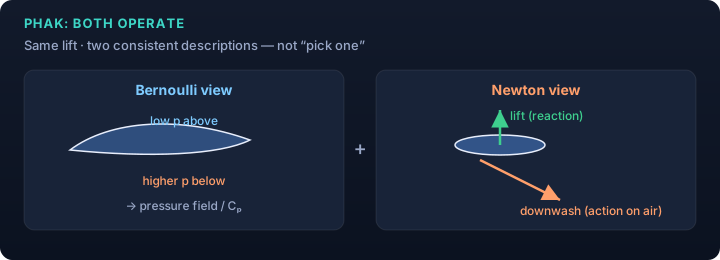
- Newton’s third law also operates: the wing imparts downward momentum to the air (downwash); the reaction is an upward force on the wing.
- PHAK: both Bernoulli’s principle and Newton’s laws are in operation whenever lift is generated.
Newton side-by-side (same PHAK section family)
| Law | Pilot-relevant picture |
|---|---|
| 1st | Body at rest stays at rest / uniform motion until forces act |
| 2nd | Force relates to mass and acceleration of the air (and airplane) |
| 3rd | Action–reaction: prop pushes air back → air pushes airplane forward; wing pushes air down → air pushes wing up |
Knowledge-test style takeaway
Faster flow over the curved upper surface → lower pressure on top of the wing (MIT 16.687 / PHAK-aligned practice framing). Keep the caveats above so you don’t oversell a cartoon.
Practice deeper
Open Lift Theory Lab → (interactive venturi, airfoil Cp, Newton, circulation / Kutta–Joukowski + myths)
Primary sources
- FAA PHAK FAA-H-8083-25C Ch. 4 — Bernoulli’s Principle of Differential Pressure; airfoil design; low/high pressure; Newton’s laws
- PHAK systems chapters — carburetor venturi (same principle)
- MIT OCW 16.687 — lift / four forces practice emphasis
Figures on this page are original educational schematics (SVG), not scans of FAA handbook art.