PHAK Ch. 5 · study note
Parasite drag, induced drag & L/D
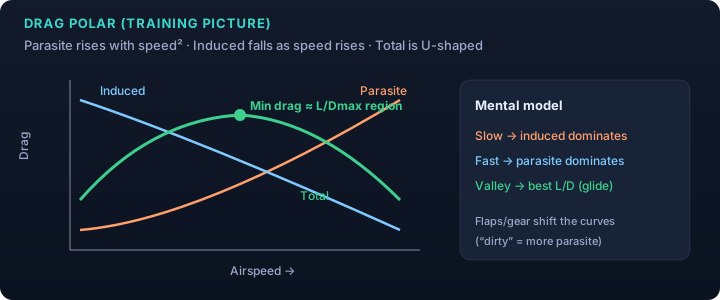
Total drag is usefully split into two families with opposite airspeed trends. That split explains why the drag curve is U-shaped and why there is a best-glide / max L/D region. Interactive: Drag Polar Lab.
Two kinds of drag
| Type | What it is | With airspeed |
|---|---|---|
| Parasite | Form, skin friction, interference — “pushing the airframe through the air” | Increases roughly with V² (dynamic pressure) |
| Induced | Byproduct of producing lift (wingtip vortices / downwash) | Highest when slow / high CL; falls as speed rises |
Mental models
- Slow flight / approach: induced drag is a big deal; dirty configuration adds parasite too.
- Cruise / high speed: parasite dominates; clean up the airplane.
- L/D max: where total drag is minimum for the lift you need — best still-air glide ratio in the simple model.
- Vx vs Vy (link): climb speeds relate to excess thrust/power, which sit on related drag/power curves (details in performance materials).
Configuration
Gear and flaps increase parasite drag (and change lift capability). “Dirty” shifts you toward higher total drag and usually a different speed for min drag. Always use AFM speeds for the configuration you are in.
Ground effect connection
Near the ground, induced drag decreases (see ground effect note). That is one reason the airplane can float or lift off early in ground effect.
Practice
Sources
- FAA PHAK Ch. 5 — forces, induced vs parasite framing
- MIT 16.687 — parasitic vs induced drag airspeed trends
Figures are original educational SVGs.
← Notes · AOA · Ground effect