PHAK Ch. 5 · study note
Ground effect
When the airplane is within about one wingspan of the surface, the ground changes the wing’s downwash / tip-vortex pattern. The practical result pilots feel: induced drag decreases.
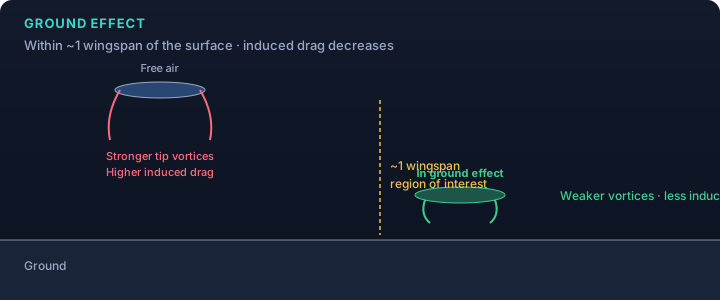
What pilots notice
- Landing: after the flare, the airplane may float longer than expected—not “magic extra lift,” but less induced drag (and related pressure-field changes) near the runway.
- Takeoff: the airplane may become airborne at a lower speed than it can sustain out of ground effect. Climbing out too aggressively / too slow can lead to a settle-back if you leave the ground-effect region without enough energy.
- Most pronounced with low wings and when very close to the surface; still taught as “about one wingspan.”
Ties to other ideas
- Induced drag is largest when slow / high CL — ground effect cuts that penalty.
- AOA / stall still rules: ground effect does not repeal critical AOA.
- Soft-field technique deliberately uses ground effect to get airborne and accelerate in the reduced-drag region (AFM/technique training).
Sources
- FAA PHAK Ch. 5 — ground effect
- MIT 16.687 — within one wingspan: induced drag ↓, early liftoff, float