PHAK Ch. 5 · MIT 16.687 · study note
Left-turning tendencies
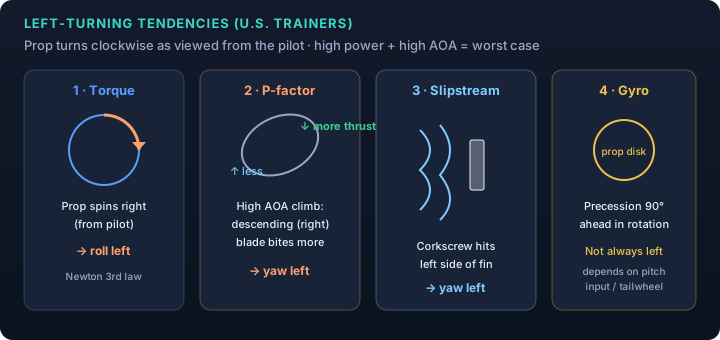
On most U.S. single-engine trainers the propeller turns clockwise as viewed from the pilot’s seat. At high power and high AOA (takeoff / climb), several effects produce left roll and/or left yaw. Right rudder is the usual antidote—not a mystery, a checklist of mechanisms.
1. Torque
Newton’s third law: propeller applies a twisting force to the air → air applies equal-and-opposite twist to the airplane. Clockwise prop (from pilot) → airplane tends to roll left. Strongest at high power; felt more at low airspeed when ailerons are less effective.
2. P-factor (asymmetric thrust)
At high AOA, the descending (right) blade has a higher angle of attack / produces more thrust than the ascending (left) blade. Center of thrust moves right → left yaw. Classic knowledge-test: left-turning from P-factor is due to the descending right blade producing more thrust—not torque, not “the prop wash only.”
3. Spiraling slipstream
The prop imparts a corkscrew of air that wraps around the fuselage and often strikes the left side of the vertical stabilizer → left yaw. Strong at high power / low speed (takeoff roll and initial climb).
4. Gyroscopic precession
A spinning prop acts like a gyroscope. A force that tries to tilt the disk shows up as a reaction 90° ahead in the direction of rotation. Whether that makes left yaw depends on the maneuver (classic: tailwheel raising the tail on takeoff). Course/PHAK note: this is not always a left-turning tendency—don’t force every yaw into this box.
When it bites hardest
| Phase | Main players |
|---|---|
| Takeoff roll / rotation | Torque, slipstream; gyro if pitch rate high (tailwheel) |
| Climb (high power, high AOA) | P-factor + slipstream + torque |
| Cruise | Much reduced (lower AOA, less power) |
Pilot actions
- Anticipate right rudder on takeoff and climb (and as needed in slow flight).
- Keep the ball centered—uncoordinated + stall is how spins start.
- Know your airplane: multi-engine and opposite-rotating props tell a different story.
Sources
- FAA PHAK Ch. 5 — propeller effects / left-turning tendencies
- MIT 16.687 Lec 2 — four mechanisms list
← Notes · AOA · Ground effect