PHAK Ch. 5 · study note
Stability
Stability is the airplane’s inherent tendency to return toward a flight condition after a disturbance (gust, brief control input). It is related to—but not the same as—controllability and maneuverability. Design trades stability against how “snappy” the airplane feels.
Axes
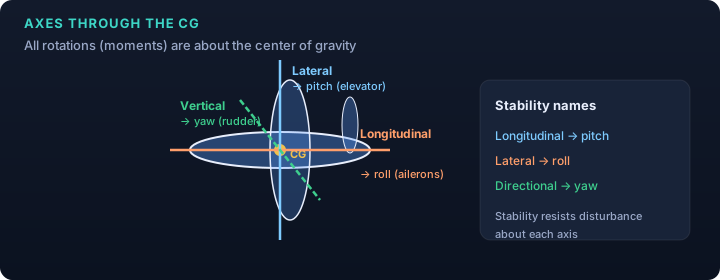
| Axis (through CG) | Motion | Stability name | Primary control |
|---|---|---|---|
| Lateral | Pitch | Longitudinal stability | Elevator / stabilator |
| Longitudinal | Roll | Lateral stability | Ailerons |
| Vertical | Yaw | Directional stability | Rudder |
Static vs dynamic
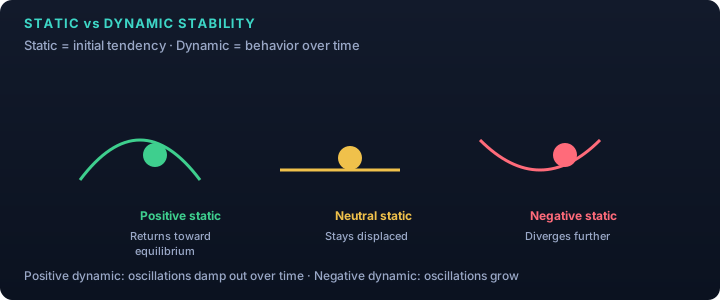
| Positive | Neutral | Negative | |
|---|---|---|---|
| Static (initial tendency) | Returns toward original attitude/path | Stays in new position | Diverges further |
| Dynamic (over time) | Oscillations damp out | Oscillations continue undamped | Oscillations grow |
Designers want positive static and positive dynamic stability for training airplanes. Too much stability can make an airplane sluggish; too little is dangerous.
Longitudinal stability (pitch)
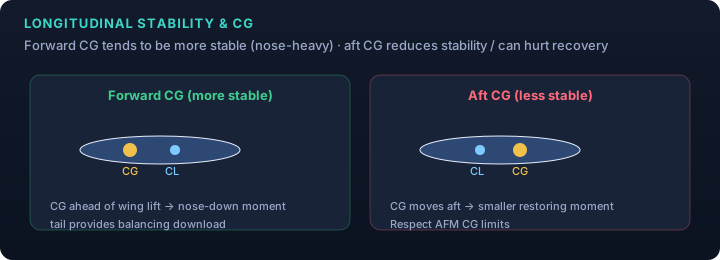
About the lateral axis. Strongly affected by CG location relative to the wing’s center of lift and by the horizontal stabilizer.
Lateral stability (roll)
About the longitudinal axis. Contributors include:
- Dihedral — upward wing angle; sideslip raises the low wing.
- Keel effect / high wing — side area and wing position act like a weathercock in roll/sideslip coupling.
- Sweepback — more advanced designs; less critical for basic trainers.
Directional stability (yaw)
About the vertical axis. Usually the easiest stability to provide: more side area aft of the CG (fuselage + vertical stabilizer) weathervanes the nose into the relative wind. A larger vertical fin → stronger directional stability.
Stability vs controllability (pilot view)
- Stable airplanes tend to hold attitude; good for IFR/cruise, easier to trim.
- Less stable / aft CG can feel lighter on the stick—easy to overcontrol; respect loading.
- Weight & balance is not paperwork only—it is a stability and control limit. See weight and balance and the W&B Lab.
Sources
- FAA PHAK Ch. 5 — Stability; longitudinal / lateral / directional; axes; CG effects
Figures are original educational SVGs.