PHAK Ch. 5 · study note
Forces in turns, climbs & descents
In straight-and-level unaccelerated flight the four forces balance: lift = weight, thrust = drag. In maneuvers those equalities change—but in a steady climb, descent, or turn, forces still form a closed balance; the pieces just rearrange.
Level coordinated turn
You bank so total lift tilts. The vertical component of lift must still equal weight (to hold altitude). The horizontal component provides the centripetal force that curves the flight path. That means total lift must be greater than weight → load factor \(n = 1/\cos\phi\).
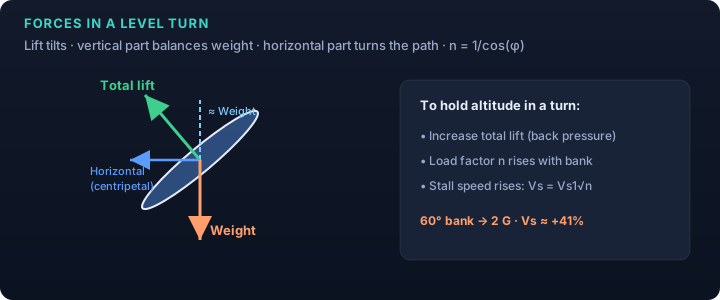
- 60° bank → 2 G; stall speed ≈ 1.41 × 1 G stall speed.
- A constant-altitude 90° bank is not sustainable (n → ∞ mathematically).
- Uncoordinated flight (ball not centered) changes the force picture and raises spin risk if you stall.
Steady climb and descent
| Maneuver | Key idea |
|---|---|
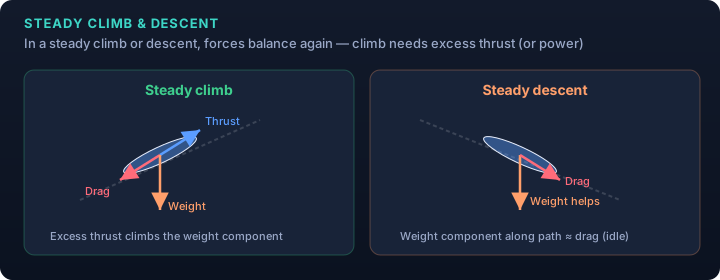
| Steady climb | Thrust > drag along the flight path; excess overcomes weight’s rearward component. Climb angle/rate limited by excess thrust/power and drag. |
| Steady descent / glide | Weight helps pull you down the path; thrust may be low or zero. Best glide relates to max L/D (see drag polar). |
| Level turn | Lift > weight; horizontal lift turns you; n and stall speed rise with bank. |
Pilot takeaways
- Add power and/or reduce bank if you lose altitude in a turn (or lower the nose carefully—know your goal).
- Steep turns: energy, stall margin, and coordination matter together.
- Climb performance is a density-altitude story as much as a “pull” story—see density altitude.
Practice
AOA & Load Factor Lab → Drag Polar Lab
Sources
- FAA PHAK Ch. 5 — Forces in Turns, Climbs, Descents; load factor